
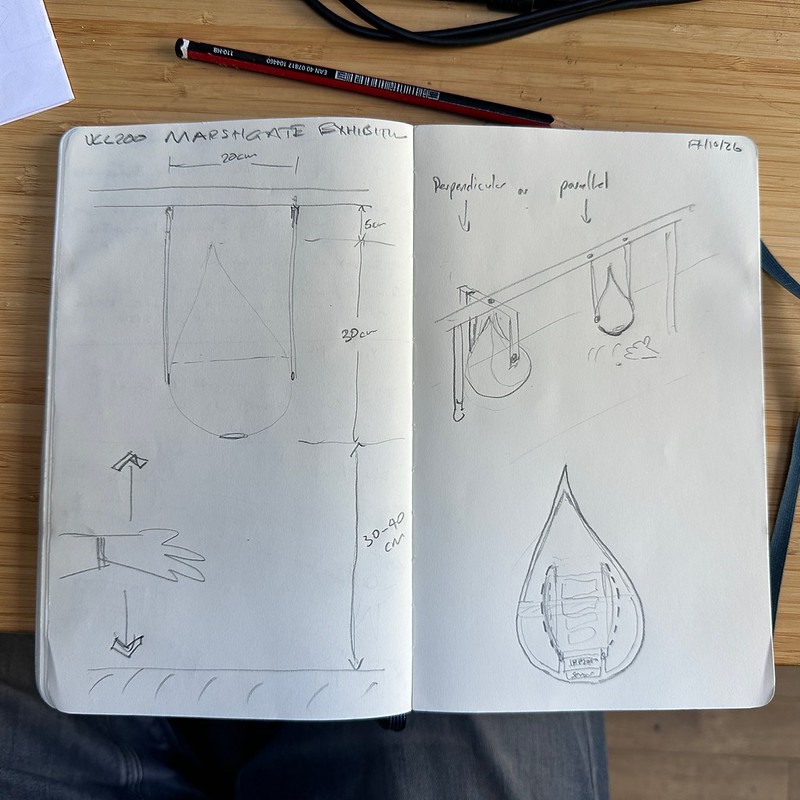
This last week a side project has been taking shape. As part of the Manifold project with Emma Smith we are installing an interactive House Mill water height sensor inspired by Satrias design - project 20 / 2024 from our 23/24 intake of students. This meant remodelling the device to incorporate Neopixels.
Watching a few colleagues exploring Claude and Blender integrations I started off seeing if Antigravity and Fusion would speed up the design process. After an hour of exploring prompts to generate Python code I realised I was missing the fun bit of the visual exploration that Fusion affords. So my strategy changed.
I reverted to building directly via the Fusion interface with guiding support from Gemini open in side browser. Rather than searching for “how do I…” in the help or via Google, I found myself chatting with Gemini to develop strategies and then used a large dose of screenshots to help ask the questions I wasn’t quite sure how to phrase (each of the screenshots below represents a question being asked). The AI did take me down a blind alley at one point (creating a connection surface that wouldn’t print) but on the whole probably sped up the process for me.

On reflection this led to quite a personalised way of learning the tool. The result is a good first prototype. If I could invest a few more days I would probably start again and focus more on a parametric design - I really appreciated the benefit that would afford half way through this design!

Will continue to keep an eye on how AI is integrated with 3D modelling since I will never be able to invest the 10,000 hours to develop the craft but have enough cases where I want to create an enclosure or a widget. But still not convinced that prompting the computer to make something will be quite as fun as sculpting the emergent form of a complex shape on the computer screen.

Still some work to complete to get the animations how we want them and the low energy settings for when the exhibition is not open (device is battery powered), but getting there.
During teaching this week (introduction to the TIG stack for storing IoT data) I was helping a student debug why they couldn’t remotely access their RPi on our PiCloud:

Turns out it needed a reboot which was easy via Steves PiCloud dashboard (only visible in the lab or when on VPN at picloud.cetools.org)


Really lovely little web app for helping you find your RPi in the sea of 50 in the cloud and doing simple admin like checking temperatures, connectivity and in my case, a remote reboot.
Looking at links.duncanwilson.com, these parts of the internet crossed my path this week:
- Loved this talk by Kevin Slavin via Russell - resonated with the eDNA sensing we do with CBER lab our neighbours at UCL East.
- Simon shared this awesome woodwork capstone project by Trey DeWolf - particularly liked his use of parametric design to create his own tools
- this is the closest I will get to flying over earth - wonder what this would feel like in VR suspended to give that floating feeling
- am sucker for these kinds of generative tools for creating art - via Andy